
How to Order Spanish Tortilla at a Restaurant
On this page
Quick answer
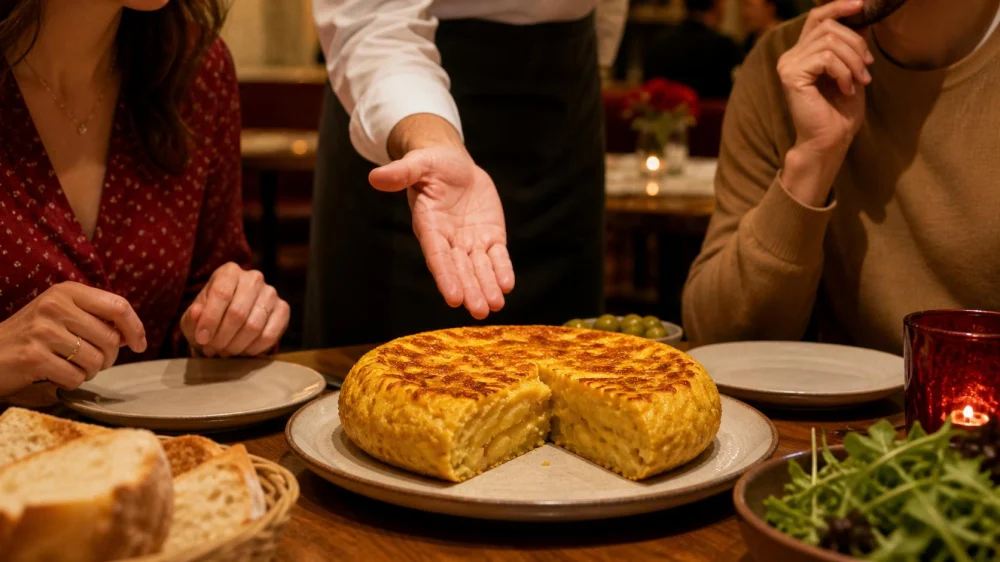
Spanish tortilla—often listed as tortilla española or tortilla de patatas—is a thick omelet built around eggs and potatoes, often with onion. Ask whether the restaurant serves it as a small tapa, an individual portion, a wedge from a larger tortilla, or a whole made-to-order dish. Then ask whether it includes onion, how set or soft the center is, what accompanies it, and how many people the portion usually serves.
It is not the same as a Mexican corn or flour tortilla; context on a Spanish menu normally makes the difference clear.

Boqueria - Colony Square
1221 Peachtree St NE Suite 110, Atlanta, GA 30361, USA
Identify the dish on the menu
Look under tapas, starters, egg dishes, or house specialties. Menus may use the Spanish name without a description. A server can explain whether it is served warm, at room temperature, as a sandwich filling, or with bread, salad, peppers, or sauce.
If the menu offers tortilla francesa, that usually means a simpler French-style omelet rather than the potato-based Spanish dish. Regional or chef variations may add vegetables, seafood, cured meat, or cheese, so confirm rather than assuming.
Ask about the restaurant's style
Two useful questions are “Does yours include onion?” and “Is the center soft or fully set?” Onion is a celebrated preference, not a universal requirement. Texture can range from creamy and gently set to firm enough for a neat wedge.
Do not demand an off-menu doneness change if the tortilla is prepared in advance as one large round. If it is made to order, the kitchen may have options, but food-safety policies and the chef's method still apply. Ask what the restaurant actually serves.
Choose a portion and place in the meal
A tapa-sized wedge can join several shared plates. A larger portion with salad or bread may work as a light meal. A whole tortilla can be substantial and may require advance notice. Ask for the number of pieces or the server's practical sharing estimate instead of guessing from price alone.
For a balanced shared order, combine the tortilla's rich egg-and-potato texture with a vegetable dish, seafood or another protein if desired, and something acidic or fresh. Order fewer plates initially when the restaurant allows additions; Spanish sharing meals are easier when the table is not crowded.
Check ingredients and allergens
Egg is central to traditional tortilla. Ask about milk, butter, cheese, wheat-containing garnishes, sauces, bread contact, and the oil or preparation surface if these matter medically. Potatoes may be fried before they are mixed with egg, so ask about shared fryers when cross-contact is a concern.
Tell the server about a food allergy before ordering, identify the exact allergen, and ask the kitchen to confirm ingredients and cross-contact controls. A preference such as “no onion” is different from an allergy and should be described accurately. If the staff cannot answer confidently, choose another dish or restaurant.
Evaluate it without rigid rules
Notice whether the egg and potato hold together, the seasoning suits the style, and the exterior and center match what the server described. A soft center is not automatically undercooked by the restaurant's standard, and a firm tortilla is not automatically inferior. Regional tradition, holding method, portion style, and personal preference all matter.
If there is a problem, describe the observable issue—unexpected coldness, ingredient mismatch, or texture different from what was promised—rather than declaring one style universally authentic.
Ordering checklist
- Confirm it is potato-and-egg Spanish tortilla.
- Ask whether onion or other additions are included.
- Ask whether the center is soft or fully set.
- Clarify tapa, wedge, individual, or whole size.
- Request a realistic sharing estimate.
- Communicate allergens and cross-contact needs.
- Check accompaniments before duplicating dishes.
- Order a balanced number of shared plates.
Limitations and food-safety notes
- Recipes and menu terms vary by region and restaurant.
- This guide cannot confirm ingredients or allergen safety for a specific kitchen.
- People at higher risk from foodborne illness should discuss egg doneness with a healthcare professional and the restaurant.
- Do not rely on appearance alone to judge internal temperature or safety.
- If an allergic reaction is suspected, follow the person's emergency plan and seek urgent help as directed.
Frequently asked questions
Does Spanish tortilla always contain onion?
No. Both with-onion and without-onion versions are common, and preferences are famously strong.
Is it eaten for breakfast?
It can be eaten at different times and appears as a tapa, snack, sandwich, starter, or meal component.
Should it arrive hot?
Not necessarily. Restaurants may serve it warm or at room temperature; ask what to expect.
Can one wedge be shared?
A small wedge can be divided for tasting, but ask the server about portion size when planning a group order.
What does tortilla de patatas mean?
It literally refers to a potato omelet and is a common name for Spanish tortilla.
Cultural and safety notes
Spain's official tourism portal identifies potato omelet as one of the country's best-known foods and presents Spanish gastronomy as regionally varied. For medically necessary dining precautions, Food Allergy Research & Education recommends calling ahead, telling staff clearly, asking how food is prepared, and avoiding a dish when the kitchen cannot address cross-contact confidently.
Ask one style question
Before choosing a portion, ask: “How does your kitchen serve the tortilla today—onion or no onion, soft or firm, and how large is the piece?” That answer usually resolves the most important ordering decisions.


 New South Orange4.0 (88 reviews)
 La Marcha Tapas Bar4.0 (1193 reviews)
 Le Chalet Basque Restaurant4.0 (366 reviews)
 Spanish Sangria4.0 (493 reviews)
 Linda's Restaurant4.0 (144 reviews)
 Ole Spanish Tapas Restaurant4.0 (37 reviews)
 Creative Spanish Party Menu Ideas for Birthday Celebrations
 Spanish Appetizers with Tapas Inspiration: A Flavorful Guide
 Spanish Mediterranean Family Dinner Recipes for Warm Gatherings
 Spanish Tapas Recipes for Potluck Parties
 The Best Spanish Street Foods You Can Recreate at Home: Flavorful Recipes & Tips
 The Best Spanish Restaurants in Sacramento for Tapas and Mediterranean Flavors