
How to Order a Balanced Spanish Cheese Board
On this page
Quick answer
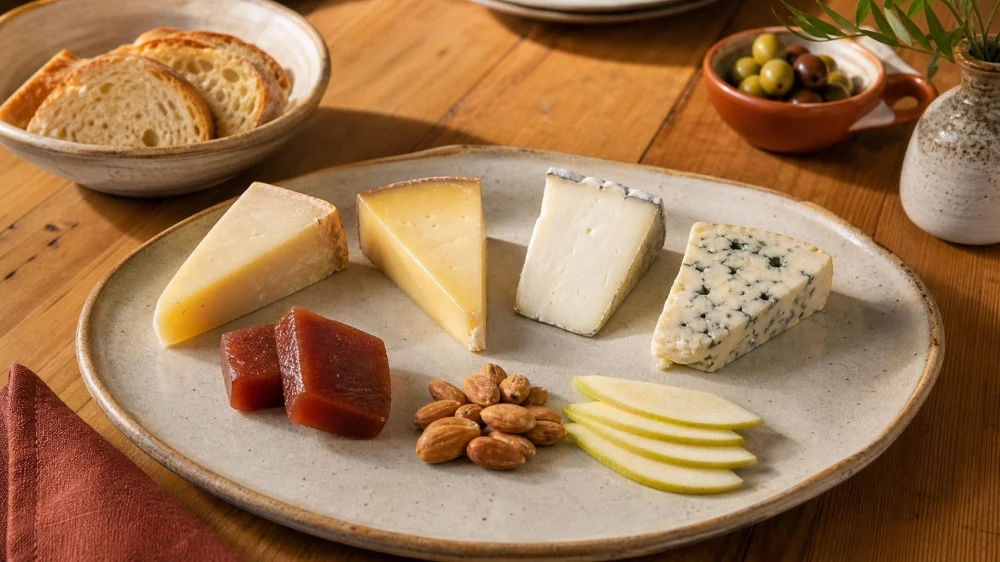
Order a balanced Spanish cheese board by choosing three to five cheeses that differ in milk, texture, age, region, and intensity. Start with a mild fresh or young cheese, add a semi-firm sheep’s- or goat’s-milk cheese, include one aged or smoked style, and finish with a strong blue or washed-rind option only if the table enjoys it. Ask for the cheeses to be served mild to strong, with modest bread, fruit, nuts, or quince paste.
A balanced cheese board is a tasting selection that creates useful contrast without repeating nearly identical cheeses or overwhelming the palate with too many intense flavors.

What makes Spanish cheese diverse
Spain’s cheese traditions reflect different climates, grazing landscapes, animal breeds, milk types, and local methods. Sheep’s milk is important in several inland regions, goat’s milk appears strongly in island and dry-climate traditions, and cow’s milk is prominent in greener northern and island areas. Mixed-milk cheeses also exist.
Region alone does not predict flavor. Freshness, starter cultures, rennet, curd handling, salting, rind treatment, smoking, cave or cellar conditions, and aging can move a cheese from soft and milky to firm, sharp, earthy, or blue.

Choose by milk, texture, and intensity
- Choose a starting cheese. Select a fresh, soft, or young style with a clean dairy flavor.
- Add a contrasting milk. If the first is cow’s milk, consider sheep’s or goat’s milk next.
- Change the texture. Move from soft to semi-firm or firm rather than ordering several cheeses with the same bite.
- Add age or smoke. One mature or smoked cheese can introduce deeper nutty, savory, or toasted notes.
- Finish with intensity. Add blue cheese only when the group wants a strong final taste.
Three cheeses are usually enough for two people as part of a larger meal. Four or five work for a group or dedicated tasting. Portion sizes vary, so ask the restaurant rather than ordering by a fixed ounce rule.
Spanish styles to look for
Manchego
Protected Manchego comes from Castilla–La Mancha and is made with Manchega sheep’s milk under its specification. Younger versions can be supple and gently tangy; longer-aged versions become firmer and more concentrated. “Manchego-style” outside the protected definition is not necessarily the same product.
Mahón–Menorca
This Menorcan cow’s-milk cheese can range from tender to aged, with increasing firmness and intensity. It provides a useful milk and regional contrast to sheep’s-milk cheeses.
Majorero
Associated with Fuerteventura in the Canary Islands, Majorero is a goat’s-milk cheese. Depending on age and rind treatment, it can add bright, savory, or fuller flavors without requiring a blue cheese.
Idiazábal
Idiazábal is a sheep’s-milk cheese associated with the Basque Country and Navarre. Some versions are smoked and others are not, so ask rather than assuming every wedge will taste smoky.
Cabrales and other blue cheeses
Cabrales from Asturias is a powerful blue style suited to the end of a tasting. A small portion can dominate milder cheeses, so it is best for diners who already enjoy blue flavors.
A restaurant may feature excellent local or artisan Spanish cheeses beyond these familiar names. Choose by the described milk, age, texture, and flavor rather than chasing only famous labels.
A practical ordering checklist
- Tell the server whether the board is an appetizer, dessert, or main tasting.
- State how many people are sharing and which strong flavors they dislike.
- Ask for one mild, one medium, and one strong cheese rather than “the best cheeses.”
- Request at least two milk types when dietary needs allow.
- Ask which cheeses are raw-milk, pasteurized, smoked, blue, or washed-rind.
- Confirm whether accompaniments contain nuts, gluten, honey, alcohol, or other relevant ingredients.
- Ask for the tasting order and begin with the mildest cheese.
A board is best for slow comparison and sharing. It is not ideal when the table has severe dairy allergy, incompatible cross-contact needs, or no interest in strong cheese; another appetizer will provide better value.
Use accompaniments without hiding the cheese
Plain bread or crackers reset the palate and provide texture. Membrillo, a firm quince paste, offers concentrated sweetness that pairs especially well with firm salty cheeses. Pear, apple, grapes, almonds, walnuts, olives, or a small amount of honey may work, depending on the board.
Use one accompaniment at a time after tasting the cheese alone. Too much jam, honey, spice, or pickled food makes different cheeses taste alike. Keep strongly flavored meat separate if the goal is to understand the cheese.
Important allergy and safety notes
All cheese contains milk proteins and is unsafe for someone with a milk allergy unless a qualified clinician has provided different individual guidance. Lactose content varies and cannot be inferred safely from a generic “aged cheese” claim for every person. Shared boards also create cross-contact through knives, hands, bread, nuts, and charcuterie.
Raw-milk cheeses have specific production and sale requirements in the United States and may pose greater risk to pregnant people, young children, older adults, and people with weakened immune systems. Ask the restaurant and follow current clinical and public-health guidance. Refrigerated cheese should not remain at unsafe temperatures for extended periods.
Sources and evidence notes
Spain’s official tourism guide to Spanish foods and cheeses notes the country’s wide regional selection and identifies Mahón as cow’s milk, Majorero as goat’s milk, and Idiazábal as sheep’s milk. Its official tapas guide lists regional cheeses including Manchego, Idiazábal, Roncal, Mahón, and Majorero. Protected designation rules apply to specific names; the restaurant should identify the actual producer and style when origin matters.
Frequently asked questions
Is every Spanish sheep’s-milk cheese Manchego?
No. Manchego is a protected regional name with a defined specification. Spain produces other sheep’s-milk cheeses, and a generic sheep cheese should not automatically be called Manchego.
How many cheeses should a board include?
Three provides a clear small tasting; four or five creates more contrast for a group. More is not automatically better because palate fatigue and duplicate styles make comparison harder.
Should cheese be eaten before or after dinner?
Either can work. In a restaurant it may be a tapa, shared appetizer, separate tasting, or closing course. Tell the server where it fits so portions and pacing make sense.
Does all Idiazábal taste smoky?
No. Smoked and unsmoked versions exist. Ask about the specific cheese on the board.
What can I drink without alcohol?
Water is the clearest palate cleanser. Sparkling water or an unsweetened nonalcoholic beverage can also work, but strong sweetness may hide subtle cheese flavors.
Next steps
At your next Spanish restaurant, request three cheeses with different milk types and intensities. Ask the server to name the region, milk, age, texture, and tasting order. Taste each alone first, then add one accompaniment, and note which contrast you would choose for a future board.

 Enoteca5.0 (2 reviews)
 Pilar Caribbean Restaurant4.0 (109 reviews)
 Bar Jamon4.0 (273 reviews)
 El Cocinero Restaurant4.0 (246 reviews)
 Tia Pepa4.0 (88 reviews)
 Telefèric Barcelona Los Angeles4.0 (364 reviews)
 The Best Spanish Restaurants in Detroit for Family Dining Experiences
 How to Make Spanish Pollo al Horno con Hierbas: Herb-Roasted Chicken
 Authentic Spanish Sangria with Red Wine and Fresh Citrus Fruits
 How to Make Spanish Churros con Chocolate: Fried Dough with Chocolate
 Authentic Spanish Chicken Croquettes Recipe Step by Step
 Traditional Spanish Seafood Soup with Fresh Herbs