
Spanish Jamón Guide: Read Cut, Breed, Feed, and Seal
On this page
- Quick answer
- Distinguish jamón from paleta
- Separate Serrano and Ibérico
- Read Ibérico sales terms
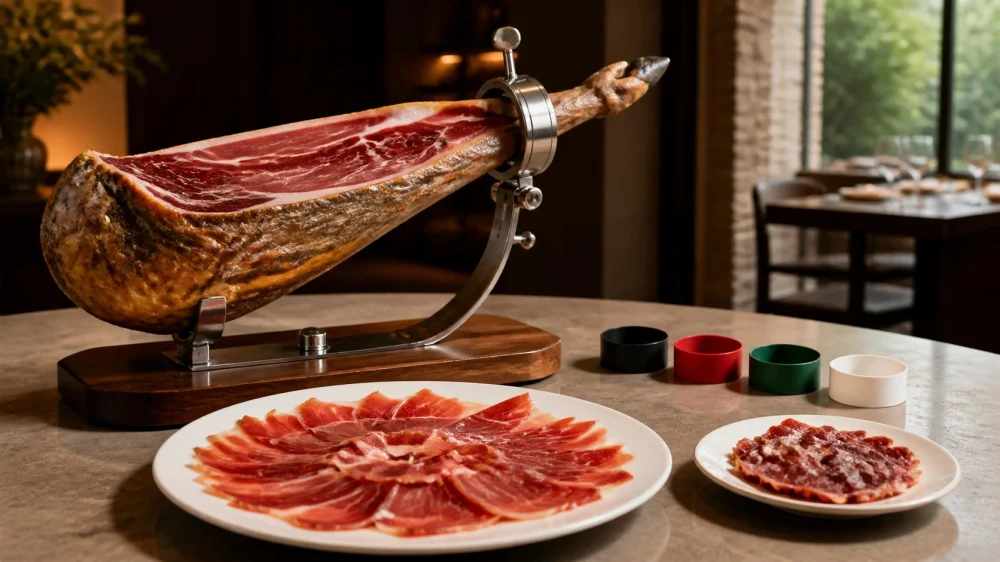
- Understand the four seal colors
- Ask useful restaurant questions
- Compare slice, aroma, and texture
- Check dietary and storage details
- Spanish jamón checklist
- Frequently asked questions
- Sources and evidence notes
- Conclusion and next steps
Quick answer
Start by identifying the product, not the menu price. Jamón is cured hind leg; paleta is cured shoulder. Serrano and Ibérico refer to different regulated product families and raw-material traditions. Within Ibérico, the full sales name communicates feeding/production category and breed percentage, and a colored official seal on a whole piece supports traceability.
Ask for the producer, full label name, breed percentage, feeding category, curing location and time, cut, portion weight, and whether slices are hand- or machine-cut. Do not infer category from marbling, hoof color, package design, or a loose phrase such as “acorn ham.”

Cruz's Food Market Evangelista
BridgetonCumberland CountyNew Jersey
42 N Laurel St, Bridgeton, NJ 08302, USA
Distinguish jamón from paleta
Jamón comes from the hind leg and is generally larger, with a different balance of lean, fat, bone, and slicing zones. Paleta comes from the front shoulder, is smaller, and can deliver more intense flavor relative to slice size. Both can be high-quality cured products, but they are not interchangeable names.
Confirm which cut is on the plate. A mixed board may include jamón, paleta, lomo, chorizo, or other cured meats. Lomo is cured loin, not a leg or shoulder. Ask whether the listed portion is the meat alone or includes bread, tomato, olives, cheese, and accompaniments.
Separate Serrano and Ibérico
Jamón Serrano is traditionally produced from white-pig breeds and dry-cured. Jamón Ibérico is produced under Spain’s Ibérico quality standard using animals with specified Iberian breed ancestry and production categories. One name is not a simple aging grade above the other.
A restaurant may use “Spanish ham” for several products. Request the exact protected or regulated name from the original packaging or supplier sheet. Country of origin, producer, curing region, and quality designation answer different questions; none should be guessed from the stand, hoof, or meat color.
Read Ibérico sales terms
Spain’s Ibérico standard distinguishes feeding and production categories including de bellota, de cebo de campo, and de cebo. “Bellota” identifies the category associated with the montanera finishing period and acorn and natural-resource feeding under the standard. “Cebo de campo” and “cebo” follow different production and feed conditions.
The breed component is separate. “100% Ibérico” has a specific meaning under the standard; other qualifying pieces state an Iberian breed percentage. Read the complete sales name, because “Ibérico” alone does not communicate both feeding category and breed percentage.
Understand the four seal colors
Spain’s Ministry of Agriculture documents four tamper-resistant seal colors for Ibérico whole hams and shoulders:
- Black: de bellota 100% Ibérico.
- Red: de bellota Ibérico.
- Green: de cebo de campo Ibérico.
- White: de cebo Ibérico.
The seal has unique traceability identification. Color is not a universal ranking system for every Spanish cured ham, and it should not be applied to Serrano products or unrelated packaging colors. For pre-sliced packs, use the complete certified label and traceability information rather than expecting the physical leg seal on each serving.
Ask useful restaurant questions
- Is this jamón or paleta?
- Is it Serrano or Ibérico?
- What is the complete sales designation?
- What Iberian breed percentage and feeding category are stated?
- Is there a protected designation of origin or other certification?
- Who is the producer and where was it cured?
- Is the portion cut by hand from a stand or by machine?
- What is the approximate serving weight?
If staff cannot verify a premium claim, order based on the available description and price rather than filling gaps with assumptions.
Compare slice, aroma, and texture
Thin slicing lets fat soften at room temperature and spreads aroma across the palate. Hand-cut slices may vary in shape and thickness across parts of the leg; machine slicing is usually more uniform. Neither method alone proves product category or quality.
Taste a slice without bread first. Note salt, cured aroma, sweetness, nutty or savory impressions, firmness, fat melting, and finish. Temperature affects texture: very cold fat feels firmer and can mute aroma. Compare two clearly identified products in small portions rather than relying on memory.
Check dietary and storage details
Cured ham is concentrated and can be high in sodium. Portion size and accompaniments matter for a sodium-restricted plan. Ask about preservatives or other ingredients when medically relevant and use the original product documentation, not a general assumption that all traditional ham contains only pork and salt.
For food allergy or religious and ethical restrictions, review shared slicers, boards, knives, bread, cheese, and mixed platters. Pregnant people, older adults, immunocompromised people, and others with specific food-safety guidance should follow their healthcare professional and current public-health advice about ready-to-eat cured meats.
Spanish jamón checklist
- Confirm hind-leg jamón versus shoulder paleta.
- Separate Serrano from Ibérico product families.
- Read the complete Ibérico sales designation.
- Check breed percentage and feeding category separately.
- Use black, red, green, and white seals only in the Ibérico system.
- Verify producer, origin, certification, and curing details.
- Ask hand-cut or machine-cut and portion weight.
- Taste at an appropriate temperature.
- Check sodium, ingredients, and shared equipment.
- Keep premium claims tied to traceable documentation.
Frequently asked questions
Is paleta the same as jamón?
No. Paleta is shoulder and jamón is hind leg.
Does black hoof mean the black-seal category?
No. Use the official seal and full sales designation, not hoof appearance.
Does “Ibérico” always mean acorn-fed?
No. Feeding category and breed percentage must be read from the complete designation.
What does a green seal mean?
Within Spain’s Ibérico system, it identifies de cebo de campo Ibérico.
Is hand cutting always better?
It changes slice shape and service, but does not by itself establish category or quality.
Can a restaurant show documentation?
Many can identify the producer and label from the original piece or supplier information; ask politely.
Sources and evidence notes
Spain’s Ministry of Agriculture, Fisheries and Food maintains the Ibérico Quality Standard resources under Royal Decree 4/2014. Its official seal and designation note specifies black for de bellota 100% Ibérico, red for de bellota Ibérico, green for de cebo de campo Ibérico, and white for de cebo Ibérico.
Restaurant menus in the United States may summarize imported product names. The original certified label and current regulations govern the product claim.
Conclusion and next steps
Read Spanish cured ham in layers: cut, product family, breed, feeding category, seal, producer, and service. Ask for the complete traceable name, then compare slice and flavor. This turns a premium menu phrase into a specific product you can understand and evaluate.


 La Rambla Restaurant & Social Room4.0 (857 reviews)
 Solea Restaurant and Tapas Bar4.0 (1146 reviews)
 The Singing Sliders4.0 (2 reviews)
 Boqueria Flatiron4.0 (2233 reviews)
 La Feria4.0 (1167 reviews)
 Segovia Restaurant4.0 (2529 reviews)
 The Best Spanish Restaurants in Charlotte for Tapas and Paella Nights
 Easy Spanish Sangria with Sparkling Water Recipe Guide
 Authentic Spanish Seafood Rice with Saffron Broth Recipe Guide
 The Best Spanish Restaurants in Houston for Tapas Nights and Family-Friendly Dining
 How to Make Spanish Churros con Chocolate: Fried Dough with Chocolate
 How to Make Spanish Pollo al Horno con Limón, Ajo y Hierbas: Lemon Garlic Herb Roasted Chicken